
In the Eye of the Storm: Black Perspectives on the Trump Administration
Lead Author: Rayna Young, MPP
Introduction
In the Eye of the Storm: Black Perspectives on the Trump Administration seeks to capture Black Americans’ views on President Trump, the economy, and the lifestyle changes they’ve adopted during his first six months in office. The Center for Policy Analysis and Research (CPAR) conducted this project in two phases. For the first phase, we surveyed Black Americans after the first 100 days of the Trump Administration. For the second phase, we conducted focus groups with select participants two months after administering the survey. In the Eye of the Storm is a continuation of the Amplifying Black Perspectives series that began in 2024 with the Congressional Black Caucus Foundation’s 53rd Annual Legislative Conference.
Read more...
In recognition of our commitment to uplifting Black communities, CPAR launched an original data collection project at the conference that culminated in two reports that highlighted Black Americans’ feelings and policy concerns before the 2024 election and in the months after President Trump was elected but before he took office. Both reports explore how the intersections of race, gender, sexual orientation, and age impacted the respondents’ perspectives and lifestyles. Click the links to access the pre-election and post-election reports. If you would like to participate in CPAR research, please sign up here.
Methodology
The Center for Policy Analysis and Research (CPAR) at the Congressional Black Caucus Foundation (CBCF) conducted a study to understand the attitudes of Black Americans regarding President Trump’s first 100 days in office. For this analysis, we surveyed 101 Black adults from our CPAR research program, which is primarily composed of attendees of CBCF events. We conducted surveys from April 30-May 15, 2025. The surveys were sent via email and completed independently online. The survey questions are available here.
After the survey concluded, we invited select respondents to participate in focus groups to elaborate on their responses and see if their perspectives changed between the third and sixth months of the Trump Administration. We administered three focus groups sorted by age group with four participants each from June 25-July 2. The focus groups were held virtually on Zoom and lasted about 75 minutes. The focus group questions are available here.
How to Use
This interactive website allows users to see how their opinions compare to survey respondents across different age groups. The Profiles outline our twelve focus group participants. You can follow their responses throughout the website. In the interactive section of the website, answer the question, provide your age group, and press See Results to see how your answers compare. If you would like to see the results without submitting your information, simply click on the links below the See Results button. Use the Table of Contents to navigate between sections.
Profiles
Meet our Focus Group Participants!
Baby Boomers
Samantha
Lives in: North Carolina (Originally from Delaware)
Occupation: Political/Government Work
“I’m going to wait and watch before I make a decision. I’m hoping there’s some type of method to the madness that’s going on and that so I’m just reserving my [judgement], whether it’s praise or criticism ’cause I think it’s too early to really say.”
Sylvia
Lives in: Maryland (Originally from New York)
Occupation: Healthcare
“It terrifies me that I live in a country that I used to have a lot of pride in. And it terrifies me because right now, I don’t see a way out. I’m a person that always has a strategy and I feel very stuck.”
Carl
Lives in: Indiana
Occupation: Healthcare
“I would like to see us come back. I would like to see the Urban League come back to where they were fighting alongside with the NAACP and involving the black churches and everybody coming together. I think that’s our problem is that we’ve separated so we no longer have that strong voice to say, ‘hey, stop all of this.’”
Clara
Lives in: Ohio
Occupation: Retired Physician
“If you don’t invest in children, you’re not going to have a country. Forget about waving the flag. You’re not going to have a country anymore. You’re dumbing down the kids. You’re taking away education, you’re taking away head start, you’re taking away all kinds of grants for college. I feel like I’m back in Mississippi in 1955. That’s what this feels like to me now on so many levels.”
Gen X
Janice
Lives in: Washington, DC (Originally from Detroit)
Occupation: Currently unemployed, former COO
“We’re in an era, I would argue, that feels even larger than the civil rights era because in addition to civil rights being impacted, just what it means to be an American is being impacted.”
Sheryl
Lives in: Born and raised in Indiana
Occupation: Social Worker
“I know everybody’s not going to be in the street, but we need to be doing a whole lot more. And it just seemed like people get comfortable and just say, ‘oh, well, that’s how it is.’ And I could see things getting worse. But I don’t know what’s going to light that spark to have a mass uprising.”
Keisha
Lives in: Texas
Occupation: Nurse/Non-profit leader
“This country has never been for us. And I think that some of us who are able and capable have to change the mindset that this is the end all be all. I don’t want to continue to attempt to rebuild a country or to build a lane for me and my people in the space that never was for us. For me, reimagining what we do and don’t do in this moment also includes not being here and being OK with that.”
Erinn
Lives in: North Carolina (Originally from San Francisco)
Occupation: Researcher
“You will either do two things, you will get up and fight or you will become numb. For me, it’s about building bonds across communities. It’s about standing up in the face of adversity, not being afraid, whatever the consequences are, being willing to basically put my life on the line for what I believe in.”
Gen Z and Millennials
Aniya
Age Group: Gen Z
Lives in: Washington, DC
Occupation: Student and Political/Government Work
“I feel like a lot of policies and things that have been done outwardly have given people permission to take their masks off and be who they’ve always been or really just expose America for the underlying issues that we’ve always had. And racism has always been an issue that America’s had since 1700.”
Bree
Age Group: Millennial
Lives in: Florida
Occupation: Political/Government Work
“The cuts have already come. They’re going to keep coming. The hits are going to be long lasting. But we don’t have to sit back and continue to take it. It’s just a matter of if we say and we feel like it is outrageous. For those who engage in community, where is the collective outrage? If we say we’re disgusted, where is that? Us collectively as citizens, where do we get the gusto to say this is not and this is how we’re going to fight back in some capacity?”
Natasha
Age Group: Millennial
Lives in: Detroit, MI
Occupation: Retail
“I’m not a Republican, but I’m still paying your salary. I expect for you to uphold your oath to uphold the Constitution whether you’re Republican or Democrat. And I just feel that out of fear or just selfishness or a hunger for power, you’re just throwing your constituents, whether they’re Democrats or Republicans under the bus. And now you put the whole nation in harm’s way.”
Nadia
Age Group: Millennial
Lives in: California
Occupation: Healthcare
“Some policies this administration has changed that concern me are voting rights, reproductive rights and possible cuts to Medicaid.”
Economic Conditions
Share Your Feedback
Choose your age group and send your feedback to see survey results and quotes from your peers.
Overall Responses
96% of survey respondents did not believe President Trump took steps to make things more affordable in his first 100 days in office.
- Yes – 0%
- Somewhat- 2%
- No – 96%
- Unsure – 2%
Do you believe that President Trump has taken steps to make things more affordable in his first 100 days in office?
Gen Z and Millennials
Zero Millennial or Gen Z respondents indicated that President Trump was working to make things more affordable.
- Yes – 0%
- Somewhat – 0%
- No – 100%
- Unsure – 0%
Baby Boomers
Over 90% of Baby Boomers in our 100 days survey did not believe President Trump took steps to make things more affordable in his first 100 days in office.
- Yes – 0%
- Somewhat – 3.7%
- No – 92.6%
- Unsure – 3.7%
Gen X
Over 95% of Gen X respondents in our 100 days survey did not believe President Trump took steps to make things more affordable in his first 100 days in office.
- Yes – 0%
- Somewhat – 2.1%
- No – 95.7%
- Unsure – 2.1%
Gen Z and Millennials
- BREE: I am making the assessment of whether I have to get another side gig while I have a full-time gig to supplement additional revenue. […] The economy also affects how I approach my work. It’s a very tough spot to be in to have to tell people, “Hey, I work for the tax collector’s office” while noting that the taxes do go up and it’s just becoming like people just feel like they’re drowning. And that’s a tough conversation I find myself in because I don’t want to guilt trip people if they just don’t have what they need to have to go pay their taxes. But then there’s also the conversation just around critical services that they need. As a consumer, as a public servant, it’s a tough balancing act that I have to deal with on a daily basis.
- NADIA: The prices are still going up on groceries and other expenses. It definitely caused me to save more. A lot of the millennials and Gen Z I know are becoming more resourceful. We are not seeing job security.
Gen X
- ERINN: All of the extra shopping when I’m like, “oh, I want to go buy X,” like I’m not doing any of that. And I’m trying to keep cash on hand because if the grid goes down, I’m looking at like ‘I’m not going to be able to get to the bank, I’m not going to be able to get out, I’m not going to be able to use a card.’ So just making sure I always keep, you know, enough cash on hand if I have to do some of that.
- JANICE: I’ve been a COO for over 10 years. My last job, we just parted ways and I took a personal sabbatical. I always planned to be off for approximately a year and planned for that. I did not account for the very favorable economy to tank when this president was elected. I was always confident that within 90 days I would find something. But now, unlike prior years, there’s never been so much senior talent like highly qualified people with experience who are unemployed, specifically in DC. And so many people are calling in favors for jobs right now or applying for things that are maybe three levels down just to get work. It’s a lot.
Baby Boomers
- CLARA: I retired. So I have neither increased nor decreased my saving because my retirement funds are what they are. I am working with a financial planner who basically said they cannot plan because they have no idea what Trump is doing. And in my opinion, neither does Trump. But this is the feeling among investors. They cannot plan based on not knowing what is going to happen in the next week. Even so, there are too many variables.
- SAMANTHA: I would have to say that as far as my increase or decrease in my savings or retirement funds or stocks, it hasn’t necessarily changed. But what I have done was I don’t want a big chunk of money in my bank. I’ve been moving it into stocks and in other investments.
- CARL: I’ve seen somewhat of a decrease in my savings in that while I’m being a patient advocate, I’m also a transplant recipient. So I’ve seen my immunosuppressant drugs rise. So that money, even though I do have insurance through my job, those costs have gone up, and the money has to come to cover that from someplace else. So my savings has decreased.
- SYLVIA: I planned originally to sell my home to downsize everything. And now we’re talking about maybe when some of my grandchildren come home from college that they will perhaps want to have a place to stay because they can’t afford rent. I bought a sweat suit for one of the kids– people should take a look at their receipts because there was a $6 charge for tariffs. I mean, the extreme costs are here. People can’t sell their homes. You’ve got more people with bachelor’s and master’s [degrees] working at Walmart where the college kids can’t even get a job now.
Grocery Prices
Share Your Feedback
Choose your age group and send your feedback to see survey results and quotes from your peers.
Overall Responses
Over 90% of respondents said their groceries have increased since President Trump took office.
- Yes, my groceries are more expensive – 90.1%
- Yes, my groceries are less expensive – 1%
- No, my groceries are the same price – 5.9%
- Unsure – 3%
In general, have you noticed a change in the price of your groceries since President Trump took office?
Baby Boomers
Nearly 90% of Baby Boomers said their groceries had increased in price since President Trump took office.
- Yes, my groceries are more expensive – 88.9%
- Yes, my groceries are less expensive – 3.7%
- No, my groceries are the same price – 0%
- Unsure – 7.4%
Gen X
Nearly 90% of Baby Boomers said their groceries had increased in price since President Trump took office, but one in ten said that their grocery prices had stayed the same.
- Yes, my groceries are more expensive – 89.4%
- Yes, my groceries are less expensive – 0%
- No, my groceries are the same price – 10.6%
- Unsure – 0%
Gen Z and Millennials
Over 85% of Gen Z and Millennial respondents said their groceries had increased in price since President Trump took office, but nearly one in ten said that their grocery prices had stayed the same.
- Yes, my groceries are more expensive – 87%
- Yes, my groceries are less expensive – 0%
- No, my groceries are the same price – 8.6%
- Unsure – 4.3%
Gen Z and Millennials
- NATASHA: I work in the retail industry, and I see the price points. And all of them went up. The reason why prices were up was because of the last administration’s policies, and they were still up there, but they were going down. But now Trump is back in, it’s shooting back up again, and I see it in black and white. He’s saying, “the eggs are back to $0.99” or something little, and I’m like, what eggs are he talking about? Because I see it, it’s like $7 dollars for a dozen eggs and then the customers complain to me.
- ANIYA: I like to cook and getting basic groceries has become difficult as a college student. I’m already on a tight budget, but now I have to be extremely careful of what I buy or else I will be without for weeks until I can afford to do it again.
Gen X
- KEISHA: I might have to sell a kidney to get eggs.
- SHERYL: I don’t eat eggs. I mean, I just can’t see myself paying that much for a carton of eggs. I live by myself, I don’t have any children, so I’m like ‘Hmph. Forget that.’ No, I’m not buying those eggs.
Baby Boomers
- SYLVIA: I’ve changed my shopping habits. I shop at like four different stores, you know, for groceries and you know, I’m pretty well situated. So it’s not like I don’t have it. But I mean, I don’t need a politician to tell me what’s happening. I know how much eggs cost and I know how much groceries cost and how much I’m spending today than I was last year this time. And we don’t eat meat in here, so even the fish is high. That’s a reality check.
- CLARA: I’m acting like we’re going into a recession because this feels very much like 2008. And so, I have cut back on a lot of things, I never was a really big spender anyway, but definitely I’m much more aware of my food costs.
- CARL: We have changed our shopping habits in that we’re buying less non-essential goods. We’re being more specific in what we buy, doing more dinner planning and stuff.
Feelings on the Trump Administration
Share Your Feedback
Choose your age group and send your feedback to see survey results and quotes from your peers.
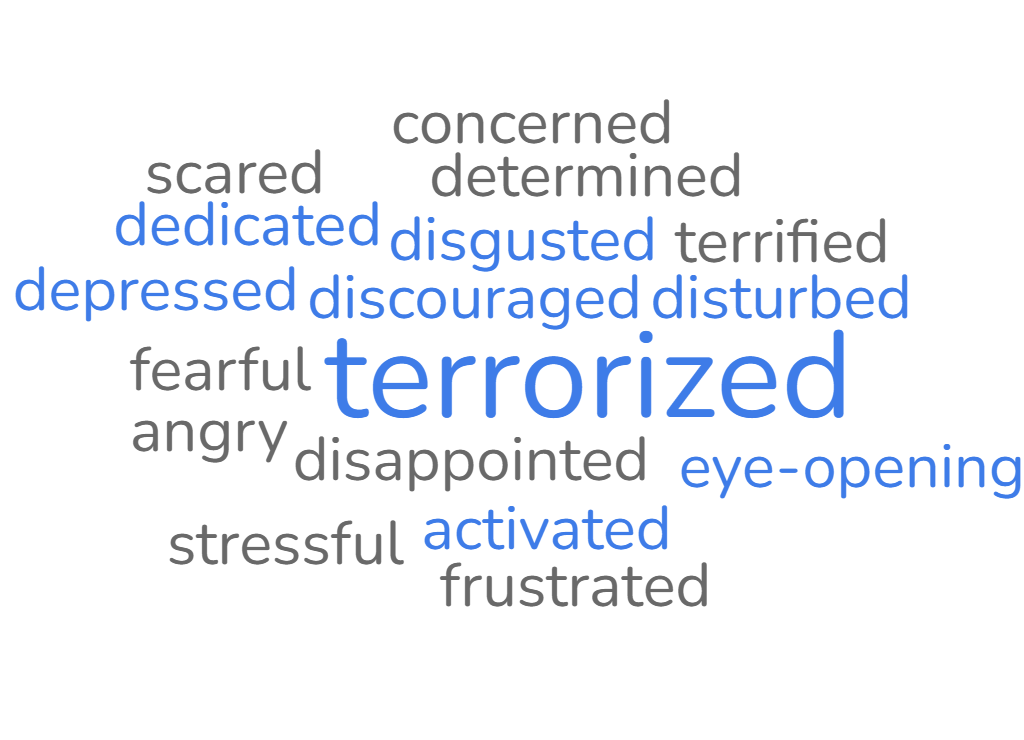
In one to two words, how do you feel about the Trump Administration?
Gen Z and Millennials
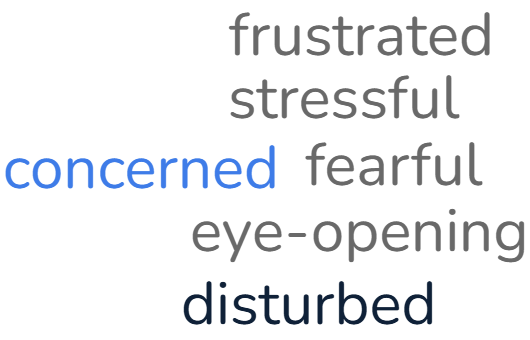
- BREE: Fearful – I’m fearful because of what the next generation will inherit. How do you build and instill joy, excitement, optimism for the next generation to come and not allow them to lose sight of everything that’s happening now and the opportunity to make things better going forward?
- ANIYA: Stressful and eye-opening – I am a federal worker. So everything that the administration has been doing… It just makes the everyday environment kind of stressful. And then eye opening because I never realized how many people don’t understand or realize how politics works but have a platform and have a following.
- NADIA: Frustrated and concerned – The two words that I would use to describe this administration are frustrated and concerned about the state of democracy, especially about housing and immigration.
- NATASHA: Disturbed – I’m disturbed because I just feel that other branches are government that are supposed to check [President Trump], they’re not doing their jobs. It feels like they kind of bend over backwards to kind of not hold him accountable.
Gen X
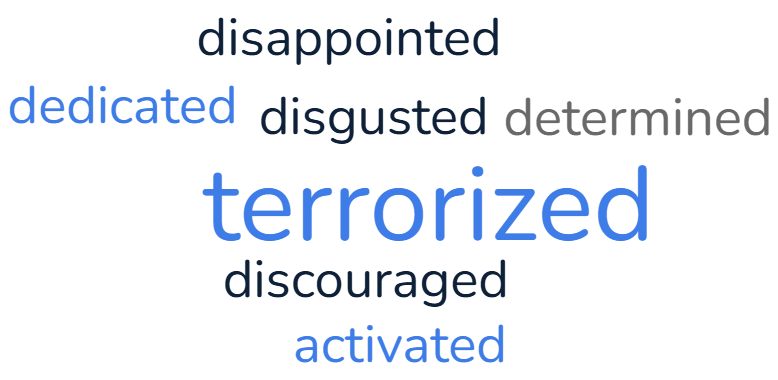
- SHERYL: Disgusted, almost terrorized – I’ve seen a lot of good work that people struggled to implement over the years just being torn down. And it’s going to hurt so many people. And it’s just not, you know, it’s not just going to hurt Democrats. I mean, it’s going to hurt everybody across the board, and it makes me very sad, makes me very angry.
- JANICE: Discouraged and disappointed – Discouraged in that I didn’t think so much damage would be done in such a short amount of time. Like, this is generations worth of harm. Disappointed by so many people who continue to support him even though it’s against their best interests.
- KEISHA: Activated and terrorized – Activated because I believe that one, we’ve been here before and two, the way out is for us to activate for our communities in our respective calling. Terrorized because Trump is a terrorist. I grew up in Harlem. I grew up with the Central Park Five. Trump has been a terrorist in my life well before he became President.
- ERINN: Determined and dedicated – I am determined and dedicated to continuing the work of my own family against anti-blackness. They have been on the frontlines through the years… so this is an opportunity for me to just tap into my purpose.
Baby Boomers
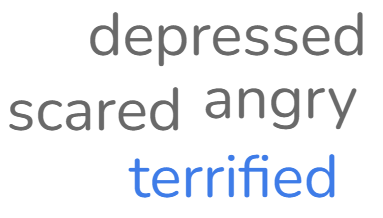
- CLARA: Angry – The thing that angers me the most is that no one is stopping it. That, you know, you have one person who’s the president, but there don’t seem to be any checks or balances that are effective in slowing this agenda. All the changes that we’ve put in place over the last 50 years to improve health and quality of life, they’ve been very gradual and very incremental. Certainly nothing happened overnight, but literally with the stroke of a pen, these things will go away and to reassemble those things will take maybe another generation.
- SYLVIA: Terrified – Never in a million years would I have thought we are where we are today given all the changes and things along that line. And the fact that there’s no one slowing it down, that it’s just moving forward at such a rapid pace that the chaos is just somewhat overwhelming and the silence is even more maddening.
- CARL: Depressed – I would say depressed knowing that those at the top who are supporting what’s been going on don’t realize what’s happening to the real people that this is affecting. It’s the people, the working class, it’s the lower income class that this is really affecting in all types of manners, not just financial, but medical, social, economic and things. So it’s really depressing.
- SAMANTHA: Scared – I have been scared, a little bit nervous, when I see the riots and things of that nature. I think more so I’m concerned about how people are reacting to what’s going on. And I don’t know how effective it is. But I’m a little bit different in the fact that I’m going to wait and watch before I make a decision. I’m hoping there’s some type of method to the madness that’s going on and that so I’m just reserving my [judgement], whether it’s praise or criticism ’cause I think it’s too early to really say, knowing only the parts and pieces that I do know.
Gen Z and Millennials
Gen X
Baby Boomers
Lifestyle Changes
Share Your Feedback
Send your feedback to see survey results and quotes from your peers.
Have you made any lifestyle changes since President Trump took office?
After 100 days of the Trump Administration…
- Nearly one in four respondents contemplated moving abroad, including 40% of Millennials and Gen Z respondents.
- “I have contemplated where I could move and live successfully out of the USA.” — A Heterosexual female Millennial from the Northeast
- “I started researching countries to move to that are democratic and economically stable.” — A Heterosexual female Millennial from the South
- Over 50% of respondents changed their travel plans, including nearly 70% of Millennials and Gen Z respondents
- “Not traveling outside of the US as planned. Too risky as an American citizen.” — A Heterosexual male Baby Boomer from the Midwest
- Two-thirds of respondents considered or adopted new personal safety measures, including over 70% of Gen X respondents
- “I have been attacked in-person and online which have resulted in me carrying personal safety devices that were never a consideration before.” — A Heterosexual female Millennial from the South
- “He has made it acceptable for people to act in uncivil ways so I must change how I interact with people because you never know who could be a bad actor.” — A Heterosexual female Gen Xer from the West
- About 25% of survey respondents re-evaluated or considered re-evaluating family planning, including more than 60% of Gen Z and Millennial respondents
- “I have expeditated family planning interventions and have also considered not traveling to red states.” — A Heterosexual female Millennial from the Northeast
Focus Group Responses to Lifestyle Changes
After six months of the Trump Administration, the primary lifestyle changes that our focus group participants raised were related to news consumption, civic engagement, and whether to leave the country.
I have considered leaving the country.
Gen X
- JANICE: I considered leaving the country and then realized I’m not, but it definitely was a consideration. If I’m honest with myself, I don’t even want to move to California because the time zone difference is too large. It was a passing thought, but I like coming to see my nieces and nephews, I like being close to my family, I like being able to pick up the phone. And I also acknowledge that while things are less than ideal here, it would be difficult to have my standard of living and comforts in some other places.
- KEISHA: I have considered leaving the country and have absolutely no problems doing so. I travel about 40% of my life now. I continue to travel. I have dual citizenship in Panama where my father was born. Just about that entire side of my family is there. I have family that is in Senegal. I could probably live almost any place and not here. My children are grown now, they can take over my property and I can be a nurse almost any place I’ll go.
- ERINN: There are four countries on my list that I have been researching. I have a great uncle who lives in Panama, so that is one option for us. My cousin passed away in March, we found out he had land in Jamaica. So in September, we’re going out there just to look and see how much it would take for us to kind of build some infrastructure on the land and get some things ready if we need to move there. The other two places are Ghana and Portugal. And I have a small backpack that if I have to leave tonight, I’m ready to go if necessary. I was born here obviously and all my ties are here but I’m recognizing that if it gets to a certain point like I might need to dip. And so I am prepared to do that.
- JANICE: I actually have a fear, I’m a person who likes to travel, but this is the first time I’ve wondered if I leave the country, could I get back in as an American citizen? It’s the only time I’ve ever had that question.
Baby Boomers
- SYLVIA: I’m afraid to leave the country. I think we might not get back in.
- CLARA: I did leave the country last month, I went to Jamaica. I needed to do that for my sanity. It’s a home country for me too, but it’s also a whole different vibe. I don’t have to look over my shoulder. I don’t feel I need to validate myself if I walk down the street or go to a restaurant. It’s a whole different sense of being. So that was very therapeutic for me. I have considered actually leaving permanently, but because of my medical condition, I don’t think that’s a possibility.
Gen Z and Millennials
- ANIYA: I have considered moving out of the country. I don’t know how long it would take me to, but I do follow quite a few people on social media who have taken up and left. At first, I’d looked at Costa Rica, and then I looked at places such as some areas in Europe, Africa. I’ve met people who are planning to move to some of those places who’ve done their research, looked into visas, immigration laws and things of that nature. I thought it’d be a lot harder in some ways, like it is to get into America, but it was eye opening for me learning about that process, especially when it comes to moving to Africa. And I move a lot already anyway. So going to a new environment has never scared me or never been off the table. But I also don’t want to feel like I’m letting this administration move me if I want to be here.
I have changed my national news consumption.
Gen X
- SHERYL: I’ve had to decrease some of my news consumption or to be very careful of what type of news I listen to or watch or some of the people I’m around because it’s not good for me. My sister has a saying: “This will not do anything to enhance the quality of my life.” If it doesn’t enhance the quality of my life as far as the news consumption goes, I’m not going to engage. Now, I will listen to news even if it’s tough news, but I can’t do a lot of opinionated like right wing talk radio. I won’t do that type of stuff. Or people who don’t know what they’re talking about. I like to consume real news so I can get real information, so I can assess the situation and know how to move. But I used to be a news junkie. I can’t do that anymore.
- JANICE: I used to be a [news] junkie. I wanted to know what bills are passed. I wanted to know all the things. But now so much is just Trump watch or ridiculousness that it gives me a headache. And so I just get the highlights. I have a few summary pages. I’ll go to those. But I’ve been watching Netflix because sometimes the regular news will breakthrough with some nonsense and I just need to disconnect.
- ERINN: I have definitely decreased news consumption, if I do watch news, it might be world news. And if I see something online, when I’m on social, I will go research it, I’m going to go look up everything, that’s probably the main thing.
Baby Boomers
- CLARA: In terms of national news, I’ve definitely decreased it, but I’m getting it more from the newspapers than TV as I find that TV is just spinning what the New York Times has said, and the newspapers actually do a more in-depth analysis on the day-to-day events. So I think I’m getting it more from print, which is kind of old fashioned, I know, but I think I get more in-depth analysis that way than from television.
- CARL: I’ve decreased my national news consumption. I think from the election until the inauguration, we very seldom watched the news at all. And then it was kind of a thing, we need to be still engaged, so we’ll turn on some things or read some things to exactly see what this administration is trying to do and what can we do to help fight against the things that are really affecting us in a negative way.
- SAMANTHA: In the past, all I watched was CNN and MSNBC, but I can’t watch them anymore. It seems like they’re all on the same talking points, and you find out that that they could be telling some of the truth, but not all of the truth. I like to look at independent news on YouTube, like Joe Rogan and shows like that. There are a couple of YouTube[rs] where they actually get out in the street and interview people, get their perspectives and things like that. I like that type of stuff as well.
Gen Z and Millennials
- BREE: I don’t have cable, I’m a streamer type of person. However, I used to be a huge consumer of news clips off of like Instagram, like I followed a news personality and I’d see snippets whatever they talked about, whatever interview they did. I used to like take in a lot of like Breakfast Club interviews, but since the election, I attuned myself more to listen to different podcasts. So I kinda at least dwindled down a bit on the actual like physical, like media consumption and challenged myself to like probably read more in terms of like articles like on Substack that are coming again from, from folks that are like vetted folks in the political space, the historical space. Just to kind of ground myself a little bit more.
- NADIA: I still watch the news, but not as much. It’s more so news clips from social media.
- ANIYA: I do watch the news, but I don’t watch like Fox or anything like that. I usually tend to watch like more international kind of based [news] and I only keep up with that because that’s what I’m studying.
I have increased my participation in civic engagement or social justice activities.
Gen X
- ERINN: My social justice activities have increased more, I feel like I’ve been doing that my whole life, but just more intentional now.
- SHERYL: I’ve increased my activism and social justice activities. I’ve been more active in my parish, ’cause we’ve always been involved in the community, of course, but we’ve had to increase, be more politically aware for some of them. There’s even talk about possibly, if it comes down to it, maybe our parish being providing a safe place for family or people who are who are at risk of ICE showing up. There’s a group, Hoosier progressives, progressive Democrats here in Indiana ’cause they’re not very happy with the state of the local party, so I’m trying to get more involved with that.
- JANICE: I’m a Delta and through my sorority, I’ve just gotten more active with different committee work and being more active in meetings, etc. So, I’ve been doing less as an individual, but more through the groups that I’m already associated with.
Baby Boomers
- CARL: Both my wife and I have increased our participation and social engagement and social justice along with the medical community and being more active in addressing our senators, our Congress people, not just at the national level, but also here at the state level. Trying to get them to understand that we are still people that you are supposed to be serving.
- CLARA: I’ve definitely increased my participation in civic engagement and social justice activities. For the first time, I went to the American Academy of Pediatrics advocacy training, which was which was excellent. I was never able to do that when I was in practice because it would mean taking two or three days off work.
- SAMANTHA: The past years since I’ve worked on a campaign, I’ve been very heavy in the civic engagement arena. And lately I feel like I want to fall back and not be so engaged or even encouraging other people too because I don’t even know if I believe there’s an effectiveness in being civically engaged. Is anyone listening? And, you know, are they really going to bring some systemic changes? So, I feel like I just want to step back a little bit on those things
Gen Z and Millennials
- NADIA: As for civic engagement, I try to engage more, but I’m very careful where and how I engage. I’m very mindful of my surroundings and safety.
- ANIYA: I do find myself engaging more in civil engagement and I’m also learning to speak up more. I don’t want it to be just a tragedy where I feel like that’s when I want to come and be there for my community. I want to be there for good moments as well as when we’re going through things.
- BREE: My commitment to social justice or community organizing, that’s probably only grown even more just because of the nuances that we have with in particular knowing how skillful and kind of innovative as an organizer, you just have to be to kind of adapt to what audience you might be wanting to connect with or what, what, what, what like feedback or thoughts or perspectives you want to gain that you didn’t always have initially in grounding me in my work.
100 Days Survey Spotlight: Policy Concerns
In the 100 days survey, we provided respondents with a list of ten policies that Donald Trump proposed during his campaign, and ten policies that he implemented once in office. We asked them to respond with their level of satisfaction or concern about the policies. Respondents were overwhelmingly dissatisfied with a wide range of policies, from President Trump’s executive orders on diversity, equity, and inclusion (DEI) and education to economic tariffs and disinvestment in foreign aid. Respondents were most satisfied with the Trump Administration’s mass deportations of immigrants and disinvestment in foreign aid, but fewer than 10% of respondents voiced those concerns. Of the proposed policies, respondents were most concerned about cuts to Medicaid, Medicare, Social Security, and Disability Insurance. Respondents were less concerned about the criminal justice policies President Trump proposed, like stricter sentencing for drug charges and the safety of transgender people.
Proposed Policies
- Dismantling the Affordable Care Act
- Cuts to Medicare and Medicaid
- Cuts to Social Security and Disability Insurance
- Taxes increasing for you and your family
- Taxes decreasing for people wealthier than you
- Federal ban on abortions
- Reduced access to contraceptives
- Increased police funding
- Stricter sentencing laws for drug charges
- The safety of transgender people
Implemented Policies
- Executive order to eliminate the Department of Education
- Mass deportations of undocumented immigrants
- Tariffs on imported goods
- Elimination of diversity, equity, and inclusion (DEI) initiatives
- Increased restrictions on voting rights
- Firing of federal workers
- Elimination of clean energy investments
- Offering support to Israel in their conflict with Palestine
- Offering support to Russia in their conflict with Ukraine
- Disinvestment in foreign aid
Focus Group Spotlight: Critiques of the Trump Administration and Non-Voters
Focus group participants were critical of President Trump, but they were also critical of those in his orbit, including his advisors and Cabinet officials, Supreme Court justices, members of Congress, Trump supporters, and those who did not vote in the 2024 election.
Gen Z and Millennials
- NADIA: It seems like there’s no checks or balances. There’s too many budget cuts and executive orders that Congress is not properly monitoring.
- ANIYA: I think a lot of people voted for this administration out of spite due to thinking that this would give people with certain backgrounds a pass or it would make things better for a particular set of people based on how they look or what race they are, as opposed to not looking at it as a whole.
- BREE: You always see the procession of when new electeds get sworn in to Congress and they put their hand on the Bible and they affirm that they’re gonna abide by the Constitution and protect the Constitution. And many of them are abdicating their responsibilities and capitulating to him. I’m disgusted by it.
- NATASHA: I’m disturbed because I just feel that other branches are government that are supposed to check [President Trump], they’re not doing their jobs. It feels like they kind of bend over backwards to kind of not hold him accountable. And it’s black and white. The law is black and white. It’s really nothing to interpret. But somehow, they’ll make up something to give him power, which is legally he is not allowed to have.
- BREE: It is very disheartening for me seeing how local governments start to back what Trump’s policies are. In particular down in South Florida where there’s just this huge conundrum of, yes, you have a melting pot of people, but in particular the Hispanic part of the melting pot voted against their interest. And just as of maybe a week or two ago local city government, in particular the city of Miami signed agreements to allow their police officers to be essentially ICE officers. And there was a huge backlash from the community. And it’s just a complete disregard for the people that you serve. But it’s very alarming to me how far folks are willing to go in office to be kind of white-adjacent when you’re really not. You’re discriminating against your own and feeling that you can kind of be untouchable. It is very alarming to me how things are going right now.
Gen X
- SHERYL: I’ve been talking with my neighbors, trying to really stress the importance of voting for them, even within my own family, because some people did sit out. You can’t sit out. And people are like, “what’s the point of voting?” Things affect you! And it’s very important to vote, and I’m trying to work through that with some people because I get so passionate about it.
- SHERYL: There are other people around [President Trump] who whisper in his ear and hype up his ego. And I just can’t understand how those people can be a part of inflicting so much damage on other people. And it’s people who voted for them too, he’s affecting those people as well. There’s been countless stories here in Indiana about the farmers who voted for him, they thought they had this contract with the government, but now they don’t because of what Elon Musk did. So now that’s up in the air, and they’re complaining about going bankrupt. It’s just a hideous thing.
- ERINN: With the whole [Project] 2025 agenda, they took a lot of years to really look at everything to see what those loopholes were and what they could do. And it breaks my heart that Congress kind of got their hands tied. What can they do? Because they’re not doing anything.
Baby Boomers
- CLARA: [President Trump] has created fear across the entire country, even our elected officials are afraid of him, which is not a good place to be in, to govern through fear and retribution.
- CARL: What was really depressing during the election itself was we had all these people who wanted to talk but did not vote. They were passive, and now they’re starting to talk because now it’s starting to affect them in ways they didn’t think would happen.
- CLARA: The thing that angers me the most is that no one is stopping it. That, you know, you have one person who’s the president, but there don’t seem to be any checks or balances that are effective in slowing this agenda.
- CARL: With the Supreme Court being that 6-3 [ideological split] factor, that’s not going to change anytime soon. That’s a whole ‘nother issue that we’re having to deal with in terms of civil rights.
Immigration - A Conversation with Baby Boomers
- SYLVIA: Half the people that are being picked up for immigration, it’s because they’re brown, not because they’ve done anything wrong. I mean, it’s like blatant racism. There’s nothing else to say.
- SAMANTHA: I worked in the food industry for many years and I worked alongside of different ethnicities and I really love meeting people of different cultures and learning their food ways and things of that nature. But when you have an influx of people that’s coming here illegally and they’ve been given so much stuff that we Americans don’t even get, then I have a problem with that. I don’t have any issue with people from other countries, but I feel like they should do it the right way and they definitely shouldn’t be getting what we should be getting.
- CLARA: I can tell you as a physician, no one’s going to let, no one’s going to let someone be sick and not treat them. So it puts physicians and healthcare people in a in a moral dilemma. If a child gets sick, has a fever to say, “oh, I can’t treat you because you’re an immigrant.” That’s a violation of our Hippocratic Oath and the oath that we take as healthcare providers.
- SYLVIA: All you gotta do is walk down to your courthouse and see who’s in there committing the most crimes. And it ain’t immigrants. I think people need to come into this country the right way too. I think there’s a way to do immigration. But I will tell you from my heart, what is happening today in, in some of these cities and with ICE going into these schools in Alabama and taking these children and ripping them from their parents. There is nothing about that in the way that any of us on this platform have been raised that that’s OK.
International Affairs and Immigration - A Conversation with Gen X
- JANICE: I don’t know how we alienate all of our allies like Canada, Europe. 1) The tariffs on our allies are problematic, 2) the way that we’re dropping bombs on countries that never bombed us without involving Congress… we have no international credibility. And that to me is a huge risk moving forward.
- KEISHA: I would agree wholeheartedly with JJ on the isolation of our allies, like, if Canada don’t like us, don’t nobody like us, right?
- SHERYL: I could definitely see ICE trying to roll up in a church and they wouldn’t think nothing of it. Nothing in this administration would surprise me.
- ERINN: If people were willing to walk for two and three months to get to the United States and you sending them back into that, like you have no heart. You are not human to me because you don’t even see, like if I had to walk out of somewhere for three months on the road with nothing but the clothes on my back, then it had to be that bad for me, right?
- KEISHA: [President Trump]’s creating slavery in some ways. Because some of these people who are just blanketly being deported are going back to environments that are so harsh and so hard to deal with and so dangerous for them. And some of them are being forced to go back to those, those places without their parents, without anyone that will have the ability to ensure their safety.
Personal Safety - A Conversation with Gen Z and Millennials
- NADIA: I’m very mindful of my surroundings and safety. I try to engage more, but I’m very careful where and how I engage.
- ANIYA: I’ve definitely changed where I shop and where I go. I’ve always tried to be vigilant in my surroundings due to areas I’ve lived, where I’ve grown up and things of that nature. But I will say now more than ever, being in some places make me uncomfortable and I don’t like that I feel that way. But just being honest, I do [feel uncomfortable] when I’m in large crowds of Caucasian people. Sometimes it’s shifted shopping experiences for me.
- NATASHA: I work for a large retailer and we have to go through training to know when like a mass shooter and how to respond. We don’t even do fire alarm tests anymore; we do mass shooting [drills]. So, I’m just used to keeping my keys and my phone on me and being ready to run out the door. Like we have to check doors three or four times a day every day. It’s a very hostile environment that we’re in right now. You probably saw on the news at a church that’s down the street from me, [a man] came in and tried to shoot up the church. Thank God the Deacon was there. You know, it’s just it’s crazy. Things are really just out of order.
- BREE: Living particularly in South Florida, there’s a stereotype around DACA recipients only being like Hispanic immigrants or Haitian immigrants. But Jamaican folks and folks well across the Caribbean are included in that as well. I talk to communities that are trying to make the adjustment from where they came from to here about being engaged. And we discuss the political systems that they have dealt with back in their home countries versus how it is here. Right now, it’s a bit off putting. As chaotic as it could be in their home countries, they kind of felt like they had some sort of weight in the matter of how it would shape out versus a constant attack on them.
Conclusion
Six months into President Trump’s second term, respondents indicated almost unanimously across age groups that they were displeased with the president’s performance. Our data suggests that Black Americans are responding to this moment by reducing their news consumption and adopting new personal safety measures while remaining engaged in social justice activities and speaking out against the policies they do not agree with. Much like in our post-election survey, the elimination of the Department of Education and Social Security cuts were still top issues of concern in our 100 Days survey. Additionally, some of our respondents’ greatest concerns at the 100-day mark were realized by the six-month anniversary of President Trump’s inauguration, including the recent passage of the One Big Beautiful Bill Act in July, which will lead to the largest cuts to Medicaid in the program’s history, and the recent ICE raids, which have led to mass deportations and increased fear in immigrant communities. Respondents characterized the President’s first six months by chaos, high prices, and a lack of checks and balances from the other branches of government. They overwhelmingly voiced disagreement with President Trump’s policies but outlined different lifestyle changes in response to this moment, from Millennials adopting new personal safety measures to Baby Boomers curbing their spending in response to economic uncertainty. As President Trump’s term progresses, we will continue to capture Black Americans’ thoughts on the political landscape.
Do you want to participate in future research from CPAR? Fill out our demographic survey here.